
How a book is made
Take a look behind the scenes to discover how much really goes on in the process of making a book - it may be more than you imagined...
T hink of your favourite children's book. What makes it special - a memorable character, the exciting plot, the richness of the language or the fun or beauty of the illustrations? Most probably, it is the perfect combination of all these features.
Very often, the most successful children's books seem the simplest and you'd be forgiven for thinking that the author and illustrator have sat down one day and poured it all out onto the page just as it is.
"It can take a couple of years from the start of an author's idea to the finished book arriving in the bookshop."
That's often the way children think it's done but making a book takes a bit more than that! There are usually a number of people involved and it can take a couple of years from the start of an author's idea to the finished book arriving in the bookshop.
Using the poster
This month's fabulous poster is a superb resource to use with children, who are always intrigued to know just how a book is made. The following notes provide you with more details of each stage to help you in your discussions with the children. Why not use this feature to help you create a class book, and let the children appreciate that that is a lot more to making a book than writing a story!
Producing your own masterpiece
Perhaps they would like to choose their role according to their strengths: some may be confident at writing, others may make good critics (the publisher) or reviewers, those with creative talents may like to create the artwork or design the pages of the book and the covers, and look out for children with business skills to promote the book to potential readers (that means everyone in school, including governors; families; local pre-schools and any local business partners). There may even be a business that would print some copies of your finished book.

Step by Step to the Poster
Step 1
Books start their life in different ways, but usually an author has an idea for a story and writes a manuscript. Some authors can take a long, long time to write, for others, it's quite a quick process. And authors have individual ways of working.
Jacqueline Wilson, for example, always buys herself an expensive Italian notebook to write ideas for a new book, others jot ideas on Post-it Notes, while some use a computer. Eventually, it will be ready to send to a publisher.
Step 2
Publishers receive many manuscripts, and they don't all get accepted for publication. There are many considerations to take into account. For a children's story book the main characters are really important: are the characters interesting or fun - will readers care enough about them to want to keep reading?; does the story have a beginning, middle and end?; if it is to be an illustrated book, is there enough visual impact? The publisher also has to think about their market - is it suitable for their range of books?; will it sell in other countries? Meetings with the sales team, marketing team and the rights team are held to discuss each book proposal.
Step 3
When the publisher has decided to accept the story, a contract is written which is signed by both the publisher and the author. The contract is a promise from the publishing company that it will manufacture, publish and sell the book and that the author will be paid a royalty (a percentage for each copy of the book that is sold).
Step 4
An illustrator is commissioned. This role varies, depending on the style of the book. For picture books, an illustrator has a lot of involvement and can add a great deal to the text. In the most successful picture books, the images tell the reader as much as the words. In fiction books for older children, the cover image is very important as this has to attract the children's attention, make them want to pick it up and find out more.
Step 5
 The sales, marketing and publicity teams kick into action! A book doesn't sell on its own - people need to know about it. The sales team sell the book to bookshop owners, librarians, book clubs and book fairs. The marketing team thinks of ways to promote the book and the publicity team makes sure the book is talked about and reviewed. The author may be asked to do interviews in newspapers and magazines, on radio and television. Book reviewers will be sent copies to write reviews in the press and on websites.
Step 6
The graphic designer works on a computer program to make the page layouts. The pictures and text are put together. There are lots of decisions about the size and shape of the book, the font and size for the type, the sizes of the images, the use of background colours or whether to use techniques such as lift-the-flaps or to have features such as glitter or cut-outs.
Step 7
Proofs are created which are checked and double-checked. Throughout the whole process checks will have been taking place but this is the last chance to make any corrections. The text needs to be checked: are there any spelling mistakes?; does it make sense?; is it consistent? The images need to be checked: are they the right colours?; are they in the right place? Does it all fit together properly? Are the page numbers right?
Step 8
When everyone is happy, the printer begins his job. The final printing plates are made and the pagination is worked out. At last the printing press is ready to roll. The pages of the books are printed on one big sheet, on both sides. If the book is being printed in different languages, then the printing plates for the text are changed and printed again. The sheets are then folded, gathered and trimmed. The cover is attached and at last the book is made! Thousands of copies of the book may be printed at one time.
Step 9

Today, books are printed all over the world, many in the Far East, so the books often have a long journey from the printers to the bookshop. It may take six weeks for the books to travel by boat from the printer to the docks in Britain. From the docks they are loaded onto lorries and taken to the publisher's warehouse. Once the customer puts in their order, the books are then despatched to their warehouse, before going on to the bookshop or library.
Step 10
The book is displayed in the bookshop or library, where it catches lots of attention.
At last! The book is being enjoyed at bedtime -- all the hard work was worth it! The author may be asked to do interviews in newspapers and magazines, on radio and television. Book reviewers will be sent copies of the book to write reviews in the press and on websites. Display the poster for all the children to see and discuss each step. They will be amazed to see how many processes are involved in making a book -- and how long it takes!
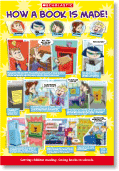 Display the poster for all the children to see and discuss each step. They will be amazed to see how many processes are involved in making a book - and how long it takes!
In this issue
Regulars
Post a comment